How to Divorce If Your Spouse Lives Abroad
If you are trying to understand how to divorce if your spouse lives abroad, the first question is not whether you need to buy a plane ticket to Russia, but which legal procedure applies to your particular situation, because a marriage can often be dissolved without the other spouse travelling to Russia simply to submit documents or attend a court hearing.
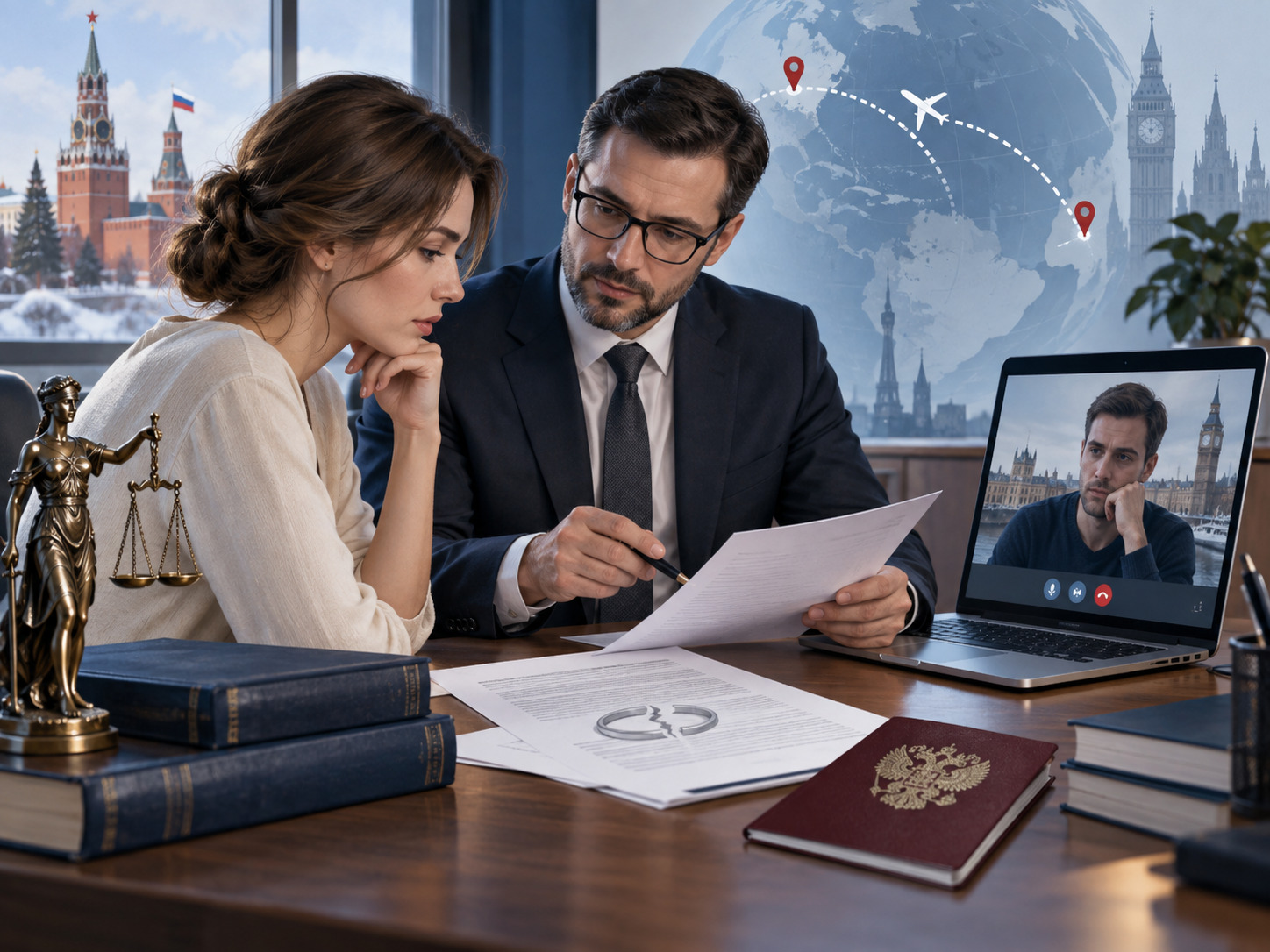
By the time a marriage reaches this point, the spouses may no longer be living in different homes but in different countries, different time zones and, judging by some exchanges of messages, entirely different universes. From the point of view of Russian law, however, distance by itself is not the real problem. What matters is where each spouse lives, their citizenship, whether there are minor children, whether both agree to divorce and whether the word “divorce” is actually shorthand for a much larger dispute involving children, property, maintenance and several years of unresolved questions.
In short: how to divorce if your spouse lives abroad?
If your spouse lives abroad, a divorce in Russia can often be completed without their travelling to Russia, but the route depends on your own place of residence, the spouses’ citizenship, whether there are common minor children and whether there are other family-law issues that need to be resolved at the same time.
If both spouses agree and there are no common minor children, an out-of-court procedure may normally be available. If there are minor children, one spouse objects or simply refuses to deal with the paperwork, the divorce will usually need to go through court. There is also a specific rule for Russian citizens living abroad. Where both spouses live outside Russia, paragraph 2 of Article 160 of the Russian Family Code allows a Russian citizen to dissolve the marriage through a Russian court regardless of the other spouse’s citizenship.
Where Russian law allows the marriage to be dissolved without court proceedings, registration of the divorce may in some circumstances also be possible through a Russian diplomatic mission or consular office abroad. The sensible starting point is therefore not a ready-made court form and not a flight booking, but working out which procedure actually applies to you.
Can you divorce in Russia if your spouse lives abroad?
Yes, but two different situations need to be kept separate.
If you live in Russia and your spouse lives abroad, the matter is dealt with under the ordinary rules of Russian civil procedure. Russian courts may hear divorce proceedings where the statutory grounds for Russian jurisdiction exist, and where the defendant has no place of residence in Russia or their Russian address is unknown, special rules may apply, including rules connected with the defendant’s last known residence or property in Russia.
If both spouses live outside Russia, the position is different. Under paragraph 2 of Article 160 of the Russian Family Code, a Russian citizen living abroad may dissolve the marriage through a Russian court where the other spouse also lives abroad, regardless of the other spouse’s nationality.
So saying “my husband lives abroad” or “my wife lives abroad” is not enough to determine where the case should be filed. You also need to know where the claimant lives, where the defendant is located, whether their address is known, whether they have property or a last known residence in Russia and whether any claims other than the divorce itself will be made.
Sometimes the marriage effectively ended five years ago and continued to exist legally simply because there was always something more urgent to deal with. Then formal marital status suddenly becomes important for a new marriage, a property transaction, an inheritance or documents in another country, and a question that sat quietly in a drawer for years needs to be resolved rather quickly.
When can you divorce without going to court?
If both spouses agree to divorce and they have no common minor children, court proceedings are usually unnecessary.
The fact that one spouse is abroad does not in itself change that. If one spouse cannot attend in person to submit a joint application, Russian law allows separate applications to be made, provided the absent spouse’s signature is properly certified. Before arranging a local notary, translations, an apostille and an expensive international courier, however, it is worth checking another possibility.
Can a divorce be registered through a Russian consulate?
In some cases, yes. Where Russian law allows a particular marriage to be dissolved without court proceedings, paragraph 2 of Article 160 of the Russian Family Code permits registration of the divorce through a Russian diplomatic mission or consular office abroad. For someone living in another country, this can sometimes be more convenient than preparing foreign notarised documents, translating them and sending them back to Russia.
I would not, however, assume that the consular route is automatically the easiest one, particularly where the other spouse is a foreign national. Whether a particular divorce can be registered by a Russian consulate may depend not only on Russian law but also on the law of the host country, applicable international agreements and the powers of the particular consular office. There is another question which can matter even more: even if the divorce is valid under Russian law, you should check in advance whether that method of divorce will be recognised in the country where you live, particularly where the other spouse is a citizen of that country.
Otherwise you can end up in the rather peculiar position of being divorced in Russia while still being treated as married somewhere else. Before choosing the consular route, I would therefore check two things at the same time: whether the relevant Russian consulate can register the divorce in your circumstances, and how that divorce will be treated in the country where you will later need to prove your marital status.
When do you still need to go to court?
Court proceedings are generally required where the spouses have common minor children, where one spouse objects to the divorce, or where a spouse does not formally object but refuses to sign documents, send papers or respond until everyone else has almost stopped expecting an answer. A lack of consent does not mean that the other spouse can block the divorce indefinitely. The court may allow time for reconciliation, but if reconciliation does not take place and one spouse continues to insist on ending the marriage, the proceedings can continue.
Russian law does not require a person to remain married indefinitely simply because the other spouse has decided to ignore the paperwork.
Do you need to travel to Russia in person?
In many cases, no, and for someone living abroad this is usually the most practical question of all. A party can participate in court proceedings through a representative and, where the procedural requirements are met, may also ask the court to hear the case without their personal attendance. This means that divorce without travelling to Russia is entirely realistic, particularly where the dispute concerns only the dissolution of the marriage.
The position changes if the divorce comes together with questions about where a child will live, contact arrangements, maintenance, an apartment, a mortgage, shares in a business or the family dinner service that has suddenly acquired the status of a national treasure. Whether a case can sensibly be handled remotely therefore depends not on the word “divorce”, but on what the case actually contains.
More information about this type of work is available on the Russian Divorce Lawyer page.
Which Russian court should deal with the case?
As a general rule, a claim is filed at the defendant’s place of residence, but divorce cases are subject to exceptions and, where the spouses live in different countries, jurisdiction is often the first point that needs to be established correctly. If the claimant is in Russia and the defendant lives abroad, with no current residence in Russia or no known Russian address, the special rules of the Russian Civil Procedure Code may apply. Depending on the facts, the defendant’s last known place of residence in Russia or the location of their property may become relevant.
In some circumstances, a divorce claim may also be filed at the claimant’s place of residence, for example where a minor child lives with the claimant or where the claimant’s health makes travel to the defendant’s place of residence difficult. This is why the advice “just file at your husband’s last registered address” sometimes works perfectly well and sometimes ends with the claim being returned and the whole process having to start again, which is rarely part of anyone’s plan when they have finally decided to close an old chapter of their life.
Justice of the peace or district court?
If there is no dispute about children and the case concerns only the dissolution of the marriage, it is usually dealt with by a Russian justice of the peace (mirovoy sudya), a first-instance judge who handles certain categories of simpler civil cases. If the parents are also disputing where the child should live or how contact with the other parent should work, the case falls within the jurisdiction of a district court.
It is therefore worth deciding before filing the claim whether you genuinely need only a divorce or whether the divorce is simply the first line in a much longer family dispute. Where there is already a dispute concerning a child, more information is available on the Russian Child Custody and Contact Lawyer page.
What if the spouse abroad does not respond?
Silence does not make divorce impossible, but the court still has to ensure that the defendant has been properly notified of the proceedings. A known foreign address, contact details and information about the spouse’s actual place of residence can therefore matter much more than they initially appear to.
The approach “they are not going to attend anyway, so the address does not matter” is risky, because the court is concerned not only with whether the person actually appeared, but also with whether they had a genuine opportunity to know that the proceedings were taking place. Once proper notification has been dealt with, the defendant’s absence does not necessarily mean that everyone else has to wait indefinitely.
Can you divorce a foreign spouse without their presence?
Yes, in circumstances permitted by law. Where a Russian citizen and their spouse both live outside Russia, paragraph 2 of Article 160 of the Russian Family Code expressly allows the Russian citizen to dissolve the marriage through a Russian court regardless of the other spouse’s citizenship.
Where the Russian citizen is in Russia and the foreign spouse lives abroad, the ordinary rules of Russian international jurisdiction and territorial jurisdiction apply, and proper service on the foreign defendant becomes particularly important. In an international divorce, however, I would not stop at the question of whether a Russian judgment can be obtained. It is also worth understanding where the judgment will later be used, whether recognition will be required in another country, where any property is located, where the children live and where the person will need to prove their marital status in the future.
Formally ending a marriage and actually closing an international family-law problem can sometimes be two different tasks.
What if you are not a Russian citizen yourself?
The special rule in Article 160 of the Russian Family Code applies to Russian citizens living abroad, so it should not be read as a general rule for every foreign spouse connected with Russia. If you are not a Russian citizen yourself, whether a divorce can be dealt with in Russia depends on the general rules of Russian international jurisdiction, the connection of the marriage and the parties with Russia, where the spouses live and what exactly you need the Russian court or another authority to do.
For a foreign spouse, there is often a second issue as well: obtaining a Russian divorce and having that divorce recognised in the country where you live are not necessarily the same task. If the Russian decision will later be used for remarriage, immigration, property, inheritance or another legal purpose abroad, recognition requirements should be checked before choosing the procedure. In many cases the matter can still be handled without travelling to Russia, but the route needs to be assessed from the foreign spouse’s position rather than by simply applying the special rule written for Russian citizens.
What if the other spouse refuses to divorce?
An objection from the other spouse does not by itself mean that the marriage cannot be dissolved. The court may allow time for reconciliation, but if reconciliation does not occur and one spouse continues to insist on divorce, the proceedings may end with the marriage being dissolved. There are specific statutory restrictions which must be considered separately. For example, a husband cannot initiate divorce proceedings without his wife’s consent while she is pregnant and for one year after the birth of the child.
Even a question that looks completely straightforward can therefore change once one additional fact is known.
Do you need to divide property at the same time?
No. Divorce and division of marital property do not have to be dealt with in the same proceedings. If property is located in several countries, there is a mortgage, shares in companies or a serious dispute over who owns a particular asset, it may be more sensible first to understand the structure of the dispute and only then decide which claims should be combined.
The same applies to children. A dispute about where a child lives or how contact with the other parent should work exists independently of how quickly the marriage itself can be dissolved. Trying to fit everything into one case can look economical only until the proceedings turn into a legal series that nobody intended to watch for five seasons.
What documents will usually be needed?
There is no universal folder called “documents for an international divorce”, however much the internet enjoys producing lists that supposedly work for everyone. Usually the starting point is the marriage documentation, information about children, details of where the spouses live, the known foreign address of the other spouse and documents relating to any additional claims. If a representative is conducting the case, an appropriate power of attorney will be required.
Where documents are prepared outside Russia, the first question should be which route makes sense in the particular country: using a Russian consulate or preparing the documents through a local notary. In the latter case, translation, an apostille or consular legalisation may be required depending on the country and the type of document.
It is much better to check this before the paperwork is completed than after the expensive envelope has already arrived by DHL from Argentina, because international documents have a remarkable habit of becoming especially beautiful at exactly the moment when the Russian authority needs a slightly different form.
Frequently asked questions
Can you divorce without the spouse abroad travelling to Russia?
Yes. In many cases, the fact that the other spouse is abroad does not require them to travel to Russia, provided the procedural and notification requirements are met.
Can you divorce without the other spouse’s consent?
Yes. Where the divorce is handled through court and no specific statutory restriction applies, the other spouse’s objection does not create an indefinite bar to divorce.
Can a divorce be registered through a Russian consulate?
In certain cases, yes, where Russian law permits the marriage to be dissolved without court proceedings. You should, however, check both the powers of the particular consulate and whether the divorce will be recognised in the country where you live.
Can you divorce in Russia if both spouses live abroad?
Yes. A Russian citizen living abroad may, under paragraph 2 of Article 160 of the Russian Family Code, dissolve the marriage in a Russian court where the other spouse also lives abroad, regardless of the other spouse’s citizenship.
Can I use a representative if I live abroad myself?
In many cases, yes. Whether the entire matter can be handled remotely depends on the claims being made, the representative’s authority and whether personal attendance is required at any particular stage.
Can you divorce a foreign spouse without their presence?
Yes, in some circumstances. The applicable route depends on where each spouse lives, Russian jurisdiction and proper service on the foreign spouse. The main section above explains the different situations in more detail.
What matters in the end
If you are trying to work out how to divorce if your spouse lives abroad, I would not begin with a ready-made claim form or a plane ticket, but with jurisdiction, the correct court or authority and the question of what actually needs to be resolved besides the divorce itself.
If you live in Russia and your spouse is abroad, one set of procedural rules applies. If both spouses live outside Russia, a Russian citizen may rely on the specific rule in Article 160 of the Russian Family Code. If you are the foreign spouse yourself, the analysis starts elsewhere, with the general rules of Russian jurisdiction and the question of how the Russian divorce will later be recognised where you live. In some cases the correct route will be a court, in others a civil registry office or a Russian consulate, and in an international marriage there may also be a separate question about whether the resulting divorce will be recognised in another country.
Once those points are clear, the thousands of kilometres between the spouses usually become an organisational problem rather than a legal one. When they are not clear, even a spouse living in the next district can make a divorce surprisingly international in the amount of paperwork and time involved.
Need help with a Russian divorce while living abroad?
This article provides general information only. The appropriate procedure depends on the spouses’ citizenship, place of residence, children, the claims being made and the documents available.