Questioning in a Russian Criminal Case: What Suspects and Witnesses Need to Know
People often walk into an investigator’s office believing that they are simply going to explain what happened, clear up a misunderstanding and go home, and that is precisely why the first questioning can become more important than they expected: three hours later they may discover that they have answered questions nobody originally mentioned, estimated dates they did not really remember, accepted somebody else’s wording and are reading a document they now want to sign for one very simple reason — they are tired and want to leave. Russian criminal procedure uses the term допрос, often translated as “interrogation”, but throughout this article I use the more neutral word questioning, because the practical issue is not whether the conversation feels dramatic; it is that this is a formal procedural action whose content may later be compared with documents, messages, banking records, expert evidence and statements made by other people.
Questioning in a Russian criminal case may involve a suspect or a witness, but their procedural positions and the consequences of their answers are different. This article deals with a person who has been called in for questioning; if you have already been detained and questioning is expected within the next few hours, the situation is different because detention, access to counsel and the first procedural documents become important at the same time, and those first steps are dealt with separately in What to Do If You Are Detained in Russia in a Criminal Case.
In short: before answering substantive questions, establish the capacity in which you have been called, what criminal case the investigator is dealing with and whether the questions may concern your own conduct rather than somebody else’s. If there is a genuine risk of self-incrimination, speaking to a Russian Criminal Defense Lawyer before questioning begins is usually much more useful than trying to repair an unfortunate answer afterwards. Do not guess dates, figures or circumstances that you genuinely do not remember, and when the questioning is over, do not treat the written protocol as routine paperwork: in Russian procedure the formal written record that you read and sign can become extremely important later.
Your procedural status matters
A suspect has the right to know the nature of the suspicion, obtain legal assistance, meet privately with defence counsel before the first questioning and either give evidence or refuse to do so. The decision whether to give evidence, and how much to say, is therefore part of the defence strategy rather than a question of being cooperative or polite with the investigator.
A witness is in a different position and is generally expected to attend and give truthful evidence about relevant circumstances. At the same time, Article 51 of the Russian Constitution protects a person from being compelled to give evidence against himself or herself, a spouse or close relatives, and a witness may attend questioning with a lawyer. The phrase “you are only a witness” should therefore not automatically be reassuring, because the real issue is not simply what is written on the summons but what the questions are actually about. If the conversation begins with somebody else’s conduct and then moves towards your own transactions, messages, documents, financial decisions or involvement in the events under investigation, the answers may already be important to your own legal position.
There is an even earlier situation that foreigners in particular can easily underestimate. Before a criminal case is formally opened, investigators may ask a person to come in to “give an explanation” or “clarify a few points” during a preliminary inquiry. This is not the same procedural action as formal questioning and a formal interrogation protocol is not drawn up, but the explanation becomes part of the inquiry materials and may later be compared with what the person says after a criminal case has been opened. Russian law also provides at that stage for protection against self-incrimination and access to legal assistance, so a friendly invitation to “just come in and talk” should not be treated as legally meaningless.
A witness should also understand that his or her position is not identical to that of a suspect. Where Article 51 or another recognised testimonial privilege applies, a witness may refuse to answer within that protected area; outside it, a witness is not generally free simply to decline to give evidence, and Russian law provides liability for knowingly false evidence and an unjustified refusal to testify. Failure to attend without a valid reason may also lead to compulsory appearance. At the same time, if a witness decides to give evidence after the relevant rights have been explained, those statements may continue to be used in the case even if the witness later attempts to withdraw them.
Questioning in a Russian Criminal Case: What to Do
One of the most common problems is not deliberate dishonesty at all. It is the perfectly human desire to give an answer. A person does not remember the exact date but offers one anyway, is unsure of the amount but gives an approximation, heard something from somebody else but describes it as if it were personally observed, and gradually begins filling gaps in memory instead of simply saying: “I don’t remember”, “I don’t know” or “I did not see that myself”. Later, those seemingly minor details are compared with documents or other evidence and what looked like an attempt to be helpful becomes a contradiction that now has to be explained.
There is therefore a significant difference between “I saw it”, “someone told me” and “I assumed it”. If you personally witnessed an event, that is one source of knowledge; if another person told you about it, that is another; if you merely reached a logical conclusion from the circumstances, that is something different again. An assumption does not become a fact simply because the investigator asks the question confidently.
The same caution applies to questions that already contain a proposed conclusion: “You already knew what the money was for, correct?”, “So you had agreed this in advance?” or “The payment was therefore made in exchange for that?”. Leading questions are prohibited under Russian criminal procedure, but even apart from that rule, the practical point is straightforward: answer on the basis of facts you actually know rather than adopting a ready-made version simply because somebody else has presented it persuasively.
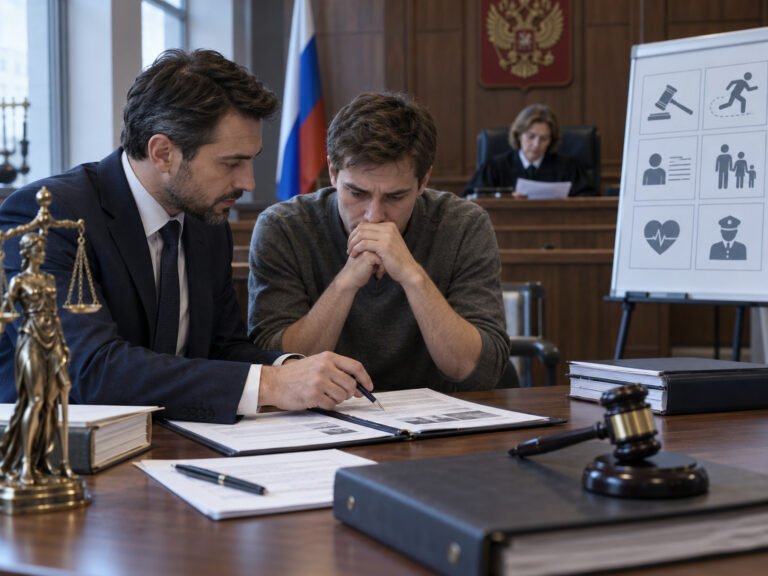
Having a lawyer in the room does not mean that questioning turns into a courtroom scene in which counsel interrupts every second question. A lawyer attending with a witness may give brief consultations, ask questions with the investigator’s permission, make written comments concerning the accuracy and completeness of the protocol and raise violations of the witness’s rights so that they are reflected in the record. The value of legal assistance is therefore much more practical: identifying the moment when a question creates a self-incrimination issue, preventing the person from speculating and making sure that the written protocol reflects what was actually said rather than a shorter, cleaner or more convenient version of it.
If there is concern about how the questioning itself will later be described, a person may request audio or video recording. Such recording does not replace the written protocol and certainly does not make reading it unnecessary, but it may provide an additional objective record of what happened.
How long can questioning last?
As a general rule, questioning may not continue for more than four hours without a break. After that there must be a break of at least one hour for rest and food, and the total duration should not normally exceed eight hours in one day.
Those limits are not merely technical. After several hours of concentrated questioning people become tired, less precise and much more willing to accept wording simply because they want the process to end, which is exactly why the final stage – reading the written record – should not be treated as an afterthought.
If a minor is being questioned
Different rules apply to a minor suspect or accused person. Defence counsel is mandatory, questioning may not continue for more than two hours without a break or more than four hours in total in one day, and in the circumstances provided by law a teacher or psychologist must also participate.
These safeguards matter because a young person may tire more quickly, agree more readily with an adult’s wording and have greater difficulty understanding the procedural consequences of an answer. Questioning a minor should therefore not be treated simply as a shorter version of questioning an adult.
If you do not speak Russian well enough
For a foreign national, language is not a minor practical inconvenience but a procedural issue. A witness has the right to give evidence in a language he or she knows and to use an interpreter free of charge, and comparable language protections apply to other participants in criminal proceedings.
If you do not understand Russian well enough to follow every legal formulation, do not sign a protocol simply because somebody has given you a quick oral summary of it. The risk is not only misunderstanding the question; it is also signing wording that you would never have accepted if you had fully understood the document.
The written protocol deserves as much attention as the questions
By the time the investigator stops asking questions, most people are tired and mentally finished with the process, which is exactly why errors in the written record are so easy to miss. Read it slowly. Check whether “as far as I remember” has disappeared from an answer, whether an estimate has become an exact figure, whether something you heard from another person has suddenly been recorded as something you personally witnessed, and whether names, dates and amounts are correct.
If a long answer has been shortened, check that the shortening has not altered its meaning, and make sure that any refusal to answer, the presence of the lawyer and any comments or objections have been recorded properly. Asking for an inaccurate formulation to be corrected is not a confrontation with the investigator; it is a normal part of protecting the accuracy of the procedural record.
For readers used to common-law police interviews, this is one of the important differences to understand about Russian practice. Audio or video may be used, but the formal written protocol remains a central procedural record and is signed by the person questioned. Signing an inaccurate protocol and later explaining that the conversation was actually different creates a problem that could often have been prevented at the time.
If the questioning has already taken place, the situation can still be reviewed. The relevant material is not just the isolated sentence that now causes concern but the person’s procedural status, the rights that were explained, whether counsel was present, the precise wording of the questions and answers, any corrections made to the protocol and the way the prosecution is now using those statements in the overall case. Where another lawyer already acts in the matter but there are concerns about earlier questioning or the current strategy, it is possible to obtain a second legal opinion without automatically replacing existing counsel.
Common questions
Can a witness simply refuse to answer everything?
No. A witness may rely on Article 51 and other recognised testimonial privileges where they apply, but outside those circumstances a general refusal to give evidence may carry legal consequences.
Can a witness bring a lawyer?
Yes. Russian criminal procedure expressly allows a witness to attend questioning with a lawyer, which can be particularly important where the questions may move towards the witness’s own conduct.
What happens if I do not attend?
If a person has been properly called and fails to attend without a valid reason, compulsory appearance may be ordered. If there is a legitimate reason why attendance is impossible, it should be communicated in advance.
Can I change my statement later?
Further statements can be given and inconsistencies can be explained, but an earlier statement does not simply disappear from the case. A witness is specifically warned that evidence already given may continue to be used even after a later refusal.
What if I cannot read Russian well enough to check the protocol?
Use your right to an interpreter. Do not sign a procedural document whose wording you do not properly understand.
Have you been called for questioning in Russia?
If you have been called for questioning as a suspect or witness and the questions may concern not only somebody else’s conduct but also your own decisions, transactions, documents or communications, it is usually better to assess your position before the questioning begins rather than after the protocol has been signed.
Legal information reviewed as of 26 September 2026. This material provides general information on Russian law and does not constitute individual legal advice. The appropriate approach to questioning depends on the person’s procedural status, the circumstances of the criminal case and the questions being asked.