
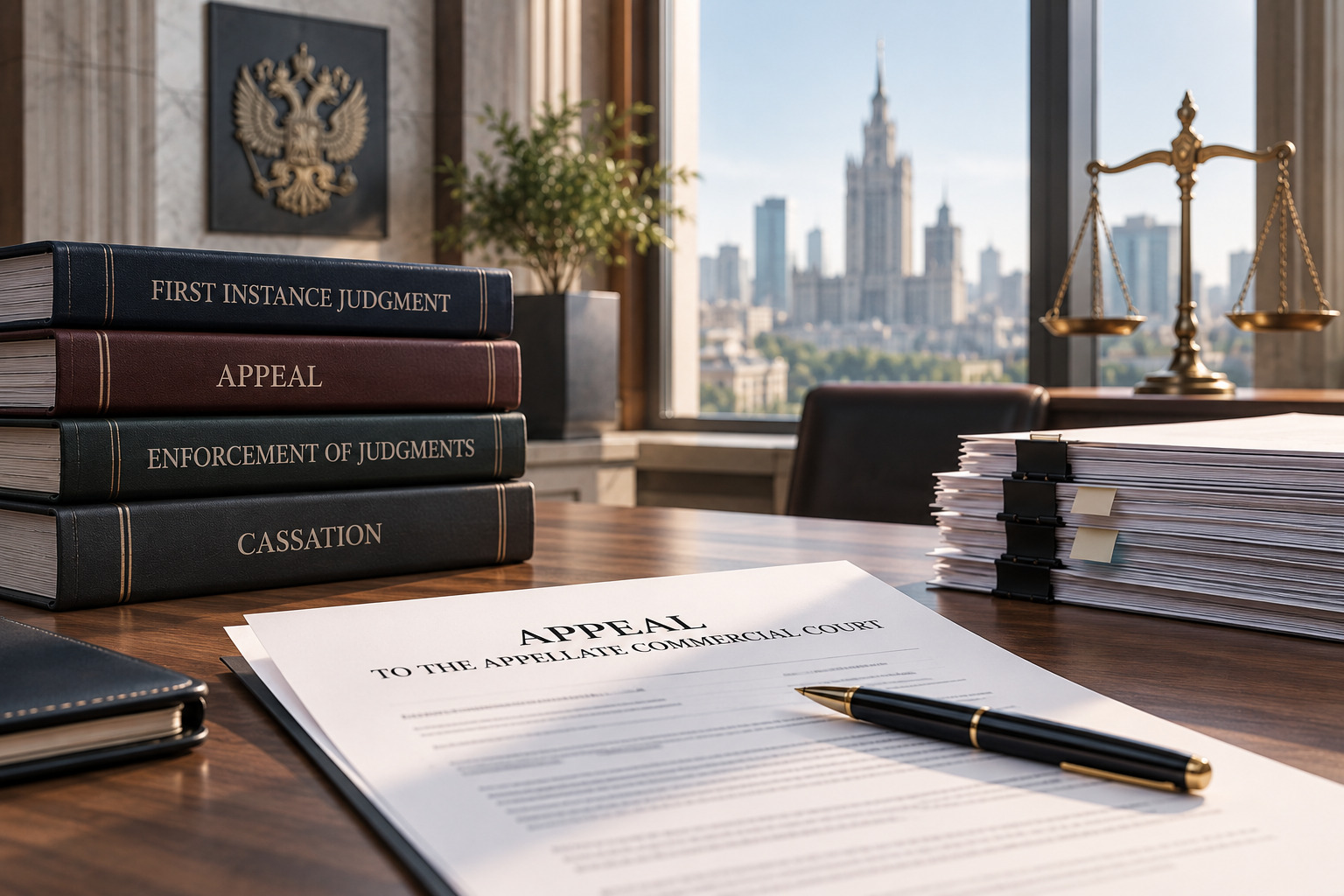
How to Appeal a Russian Commercial Court Judgment
Receiving an unfavourable judgment from a Russian commercial court and immediately deciding that it must be appealed is entirely understandable, particularly where the judgment orders a substantial payment, affects the company’s assets or comes at the end of a dispute that has already taken months of management time and legal work.
But disagreement with the outcome is not enough on its own to create a strong appeal. I would not begin with an online template or by rewriting everything that was already argued before the first-instance court; I would begin by asking what the court actually found, which evidence it relied on, which arguments it accepted or rejected, how it applied the law and whether there is an identifiable error that could genuinely have affected the result.
Sometimes that review reveals a clear appellate point, and sometimes it shows that the real difficulty arose earlier because important evidence was not produced, a necessary application was not made, the claim was framed badly or the case was conducted in a way that cannot now be completely rebuilt on appeal.
There are also cases where the outcome is commercially painful but the judgment itself is legally relatively robust. In that situation, the useful question is not how to make the appeal sound more forceful, but whether continuing the dispute through that particular route is likely to achieve anything meaningful.
Russian state commercial courts are traditionally called arbitrazh courts in Russian legislation. They mainly deal with business disputes involving companies and individual entrepreneurs, together with other commercial matters assigned to them by law, and they form part of the state court system rather than the system of private arbitration. Throughout this article I use the term Russian commercial court, because it is clearer for an international reader and avoids a distinction that is obvious in Russian but frequently misleading in English.
If you need the short version
A Russian commercial court judgment can generally be appealed within one month.
The appeal is addressed to the appellate commercial court but filed through the court of first instance that issued the judgment.
A proper appeal needs to identify a specific legal, factual or procedural error capable of affecting the outcome.
New claims cannot be introduced on appeal, while additional evidence normally requires an explanation of why it could not have been produced earlier for reasons beyond the party’s control.
If a timely appeal is filed, an ordinary first-instance judgment will generally not enter into force until the appellate court has ruled; where enforcement creates an immediate risk, a stay of enforcement may also need to be considered.
How long do you have to appeal?
As a general rule, an appeal against a judgment of a Russian commercial court must be filed within one month after the judgment is made, unless a different period applies to the particular category of proceedings. This is why I would not leave the case untouched for several weeks and then try to understand the entire procedural history during the final days of the appeal period, because the difficult part is usually not typing the appeal itself but working out which points are actually worth pursuing.
The reasoned judgment needs to be compared with the claim, the defence, the evidence and the applications made during the proceedings so that it becomes clear what the court accepted, what it rejected and why. That review is usually where the difference between a genuine appellate argument and understandable dissatisfaction with the outcome begins to emerge.
A missed deadline may in certain circumstances be restored where the reasons for the delay did not depend on the applicant, but restoration itself is subject to procedural limits, including the relevant six-month statutory framework. A missed appeal period should therefore be analysed by reference to exact dates and documents rather than on the assumption that the court will either inevitably restore it or inevitably refuse to do so.
Where is the appeal filed?
The appeal is considered by the competent appellate commercial court, but it is filed through the commercial court of first instance that issued the judgment. The first-instance court then forwards the appeal together with the case materials to the appellate court.
It is a straightforward rule, but it becomes considerably less straightforward when somebody is preparing documents during the final days of the appeal period, which is why the route of filing should be checked before anything is sent rather than afterwards.
What should actually be challenged?
One of the weakest forms of appeal is a document that says, in substance, that the court assessed the facts incorrectly, failed to take the defendant’s arguments into account and therefore reached an unlawful conclusion. That language sounds legal, but it does not tell the appellate court where the actual error lies.
The judgment may have treated delivery as proved even though the documents do not establish receipt by the defendant, attributed decisive legal significance to a document whose effect was disputed, applied rules governing a different type of contractual relationship, overlooked a material objection, allocated the burden of proof incorrectly or drawn a conclusion that does not follow from the evidence in the file. The purpose of the appeal is therefore not to retell the entire dispute more emphatically, but to identify the particular problem in the judgment and explain why that problem matters to the outcome.
Can new evidence be submitted on appeal?
Potentially, yes, but an appeal is not intended to give a party a second opportunity to produce documents that could have been submitted before the first-instance court without difficulty. Additional evidence may be accepted where the party demonstrates that it could not present that evidence earlier for reasons beyond its control, and one express example is a situation in which the first-instance court refused an application to obtain the relevant evidence.
Simply saying that another document has now been found is therefore not enough. The appeal needs to explain why the document was not before the first-instance court, what prevented its earlier production and why that explanation should be treated as a proper reason rather than an attempt to repair the case after judgment.
Can you change the claim on appeal?
New claims that were not considered by the first-instance court cannot simply be introduced during the appeal, which is particularly important in commercial disputes because an unsuccessful party may decide after judgment that the whole structure of the case should have been different. It may want to introduce another claim, change the subject of the dispute or effectively start a different case inside the existing proceedings, but that is not the function of an appeal.
Where the underlying problem arose when the original claim or defence was formulated, the position needs to be analysed separately. Some mistakes may still be relevant to the appellate arguments, while a genuinely new claim may require a different procedural route.
Is another lawyer already handling the case?
If another lawyer is already conducting the proceedings and recommends an appeal, but you are not sure whether the proposed arguments are strong, why that particular strategy has been chosen or what the next procedural steps will actually achieve, it is possible to obtain a Second Legal Opinion without automatically replacing existing counsel.
In that situation I review not only the proposed appeal but also the judgment, the first-instance materials and the procedural history of the case, because an appeal cannot be assessed properly without understanding what happened before the judgment was made.
What happens to enforcement while the appeal is pending?
For a company ordered to pay a substantial sum, this is often the most urgent practical question in the entire case. As a general rule, a first-instance commercial court judgment enters into force after the one-month appeal period expires if no appeal has been filed, while a timely appeal normally means that the judgment, if it is neither changed nor set aside, enters into force when the appellate court issues its ruling.
There are judicial acts that are subject to immediate enforcement under specific rules, so the position should always be checked against the particular judgment and the category of proceedings rather than assumed from the general rule. Where enforcement itself creates an immediate risk, filing the appeal may not be the only step that needs to be considered, because the appellate commercial court may, on application, stay enforcement where the statutory requirements are met. Depending on the circumstances, this may involve the difficulty or impossibility of reversing completed enforcement and, where the procedural rules require it, questions of counter-security.
For a company facing a significant monetary judgment, I would therefore look at the appeal strategy and the enforcement risk at the same time, because a well-drafted appeal is of limited comfort if the business only begins asking about enforcement after the practical consequences have already started.
What should an appeal contain?
The appeal should identify the judgment being challenged, the case and the parties, state what the appellant is asking the appellate court to do and explain the grounds on which the judgment should be changed or set aside, with references to the applicable law, the circumstances of the case and the evidence. The required supporting documents must also be provided, including documents relating to payment of the state fee or any applicable exemption, deferral, instalment request or reduction, together with evidence that the necessary materials have been sent to the other parties.
As of 27 September 2026, the state fee for an appeal in the Russian commercial court system is RUB 10,000 for an individual and RUB 30,000 for an organisation. Formal compliance matters, but a perfectly formatted appeal does not become persuasive merely because every procedural box has been ticked. If the document never makes clear what the first-instance court actually got wrong and why that error affects the result, immaculate formatting will not cure the substantive weakness.
What can the appellate court do?
Depending on the case, the appellate commercial court may leave the first-instance judgment unchanged, change it, set it aside in whole or in part and adopt a new judicial act, or in the circumstances provided by law terminate the proceedings or leave the claim without consideration.
There is an important practical point here because lawyers who work mainly in other types of proceedings sometimes automatically ask the appellate court to “set aside the judgment and remit the case for a new trial”. That wording should not be imported mechanically into a Russian commercial court appeal. The relief requested needs to correspond to the procedural powers that the appellate court actually has in the particular situation, rather than to a familiar formula borrowed from another type of litigation.
Is an appeal always worth filing?
No. An appeal makes sense when there is a legally relevant problem with the first-instance judgment, not merely because the result was disappointing. Sometimes a review reveals a strong and specific appellate point, sometimes the real weakness lies in evidence that was never produced or an application that was never made, and sometimes the judgment is commercially unwelcome but legally relatively robust.
Before preparing an appeal, I therefore normally review not only the judgment but also the claim, the defence, the key evidence, relevant court orders, significant applications made during the proceedings and the positions actually taken by the parties before the first-instance court. Only then is it possible to distinguish between a genuine appellate argument and an attempt to repair a case that should have been conducted differently from the outset.
What happens after the appeal?
The appellate judgment is not necessarily the end of the proceedings. In appropriate cases, the next stage is a cassation appeal to the competent commercial court of cassation, and as a general rule the cassation period is two months from the date on which the challenged judicial act enters into force, unless the procedural code provides otherwise.
Cassation is not simply another full hearing of the dispute. Its limits of review are narrower than those of an appeal, and it is not intended to provide another opportunity to reargue the factual case or ask the court to reassess evidence merely because one party disagrees with the conclusions reached below. That is why the appellate stage matters strategically, because the arguments advanced, the evidence already in the case and the procedural issues raised before the appellate court may all affect what remains available later.
What documents are needed to assess an appeal?
For an initial review, I would normally need the first-instance judgment, the statement of claim, the defence or response, the principal evidence relied upon by both sides and the documents expressly referred to by the court in its reasoning. Where the dispute is complex, important procedural applications were made or the case changed direction during the proceedings, a fuller file may be necessary because the judgment alone does not always show why a particular argument failed or what happened around it.
The earlier this review is carried out after the judgment, the more time remains not only to prepare the appeal itself but also to check the evidence, supporting documents, procedural deadlines, enforcement risks and the strategy that may be required if the dispute continues beyond the appellate stage. For more information about my work on Russian business litigation, see Russian Commercial Disputes Lawyer. If another lawyer is already handling the matter and you need an independent assessment of the judgment or the proposed appeal, see Second Legal Opinion.
Frequently asked questions
How long do I have to appeal a Russian commercial court judgment?
The general appeal period is one month after the judgment is made, although different rules may apply to particular categories of proceedings, so the applicable deadline should always be checked against the specific type of case rather than assumed from the general rule alone.
Does filing an appeal stop the judgment from becoming final?
For an ordinary first-instance judgment, a timely appeal generally means that the judgment does not enter into force until the appellate court issues its ruling, provided the judgment is not set aside or changed, although special rules may apply to judicial acts that are subject to immediate enforcement.
Does an appeal automatically stop enforcement?
Not in every situation. If enforcement creates a practical risk, the possibility of applying to the appellate court for a stay of enforcement should be considered separately, together with the statutory conditions relevant to such an application.
Can I submit new documents on appeal?
Possibly, but you will normally need to explain why they could not have been submitted to the first-instance court for reasons beyond your control. An appeal is not intended to provide a routine second opportunity to produce evidence that could and should have been filed earlier.
Can I introduce a new claim in the appeal?
No. New claims that were not considered at first instance cannot simply be introduced in the appellate proceedings, so a desire to restructure the case after an unfavourable judgment may require a separate analysis of what procedural options remain available.
What is the state fee for a commercial court appeal in Russia?
As of 27 September 2026, it is RUB 10,000 for an individual and RUB 30,000 for an organisation.
Can the appellate court send the case back for a new trial?
That should not be used as an automatic request in an appeal against a judgment. The powers of the Russian commercial appellate court differ from the model familiar from some other proceedings, so the relief requested must correspond to what the court is procedurally authorised to do in the particular case.
What happens if the appeal deadline has already expired?
The first step is to establish whether there are grounds for restoration of the deadline, when the relevant circumstances arose and whether the applicable statutory limit for seeking restoration has already expired. Exact dates and supporting documents matter considerably more here than a general explanation that the delay was understandable.
What happens if the appeal is unsuccessful?
Legal information reviewed as of 27 September 2026. This material provides general information on Russian law and does not constitute individual legal advice. Appeal deadlines, restoration of missed deadlines, enforcement, admissibility of additional evidence and the prospects of further cassation review depend on the particular proceedings, procedural history and facts of the case.
Olga Sverchkova